
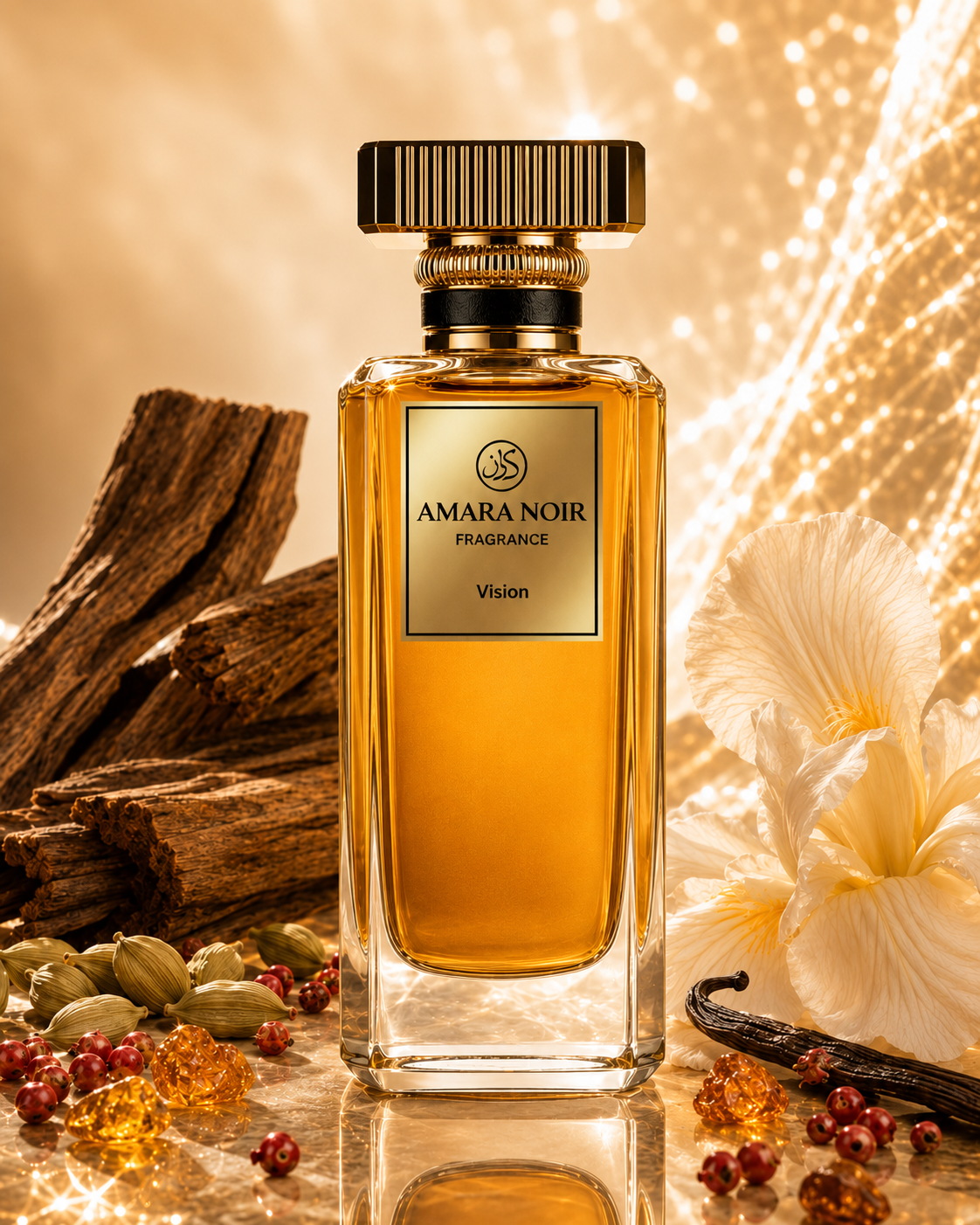
When comparing sandalwood and oakwood in perfume, read their placement and surrounding notes. Vision Intense lists creamy sandalwood with iris in the heart. Desert Bloom lists sandalwood with soft resins in the base. Origin places oakwood beside vanilla resin in the base, beneath a cinnamon-and-clove heart.
That gives you three distinct woody contexts to consider. Choosing from a wood name alone misses whether you also want spices, a floral centre or a rum-and-fruit opening. The more useful comparison begins with those combinations.
Three profiles, three different surroundings
| Perfume | Named wood and placement | Other deciding notes |
|---|---|---|
| Vision Intense | Creamy sandalwood in the heart | Cardamom, pink pepper and iris |
| Desert Bloom | Sandalwood in the base | Honey, citrus, tuberose and ylang-ylang |
| Origin | Oakwood in the base | Dark rum, dried fruits, cinnamon and clove |
The table does not create a universal rule for how sandalwood or oakwood must smell. It shows the specific relationships in these Amara Noir note maps. Those relationships can make a woody shortlist much easier to narrow.
When sandalwood sits at the heart
Vision Intense pairs creamy sandalwood with iris. Warm cardamom and pink pepper are its opening notes, and subtle vanilla resin with musk forms the base. Consider it when the wood-and-floral heart sounds as appealing as the spiced beginning.
This is a useful distinction for someone who searches for sandalwood but also wants a floral note in the central section. The shortlist is about sandalwood with iris, not sandalwood separated from everything else.
If you usually choose a spice-led perfume, notice that Vision’s opening and heart have different named roles. You can be interested in both, while deciding which one is the stronger reason for wanting to try it.
When sandalwood supports a floral centre
Desert Bloom lists tuberose and ylang-ylang in the heart. Golden honey and citrus peel form the opening, while sandalwood and soft resins sit together in the base.
Choose this as a different sandalwood context when you want flowers at the centre of the written brief. A reader who enjoys woods but hesitates over a floral heart has a concrete question to investigate here. Someone who actively wants that heart has a different reason to shortlist it.
The shared sandalwood word does not make Desert Bloom and Vision Intense variations of one decision. Their opening notes, floral pairings and base combinations give you separate profiles.
When oakwood sits beneath warm spice
Origin combines dark rum and dried fruits in the opening, cinnamon and clove in the heart, and oakwood with vanilla resin in the base. Its official family is Spiced Woody & Resinous.
If rum, dried fruit and warm spice interest you, that is a clear context for exploring the oakwood note. If they do not, a preference for woody perfume alone may be too broad a reason to choose Origin. The rest of the map should earn its place too.
Narrow the choice with one additional preference
Finish your wood-led brief by choosing an extra family you want to explore. Sandalwood with iris points towards Vision Intense. Sandalwood beneath tuberose and ylang-ylang points towards Desert Bloom. Oakwood beneath rum, fruits and warm spices points towards Origin.
Our Origin and Vision Intense comparison develops the spiced-wood decision. Explore the profiles in Private Collection with the surrounding notes in view, rather than treating either wood name as a complete perfume description.

Leave a comment
This site is protected by hCaptcha and the hCaptcha Privacy Policy and Terms of Service apply.